10-year-old Livia Quist Shines in Charming ‘Annie’ at GBSC

Nile Scott Studios
Readers and audiences alike have been fascinated by the story of a young orphan girl named Annie since the late 19th Century. The character of Annie as we know it (or, something like her) first appeared in the United States in 1885 with a poem by James Whitcomb Riley called “Little Orphan Annie” (originally titled “The Elf Child”). The poem was loosely inspired by a real orphan, Allie Smith, who came to work in the Riley family home when James was a child. In the four-stanza poem, Annie tells stories about ill-behaved children who are kidnapped by goblins. The poem ends with a warning:
“You better mind yer parunts, an’ yer teachurs fond an’ dear,
An’ churish them ‘at loves you, an’ dry the orphant’s tear,
An’ he’p the pore an’ needy ones ‘at clusters all about,
Er the Gobble-uns ‘ll git you Ef you Don’t Watch Out!”
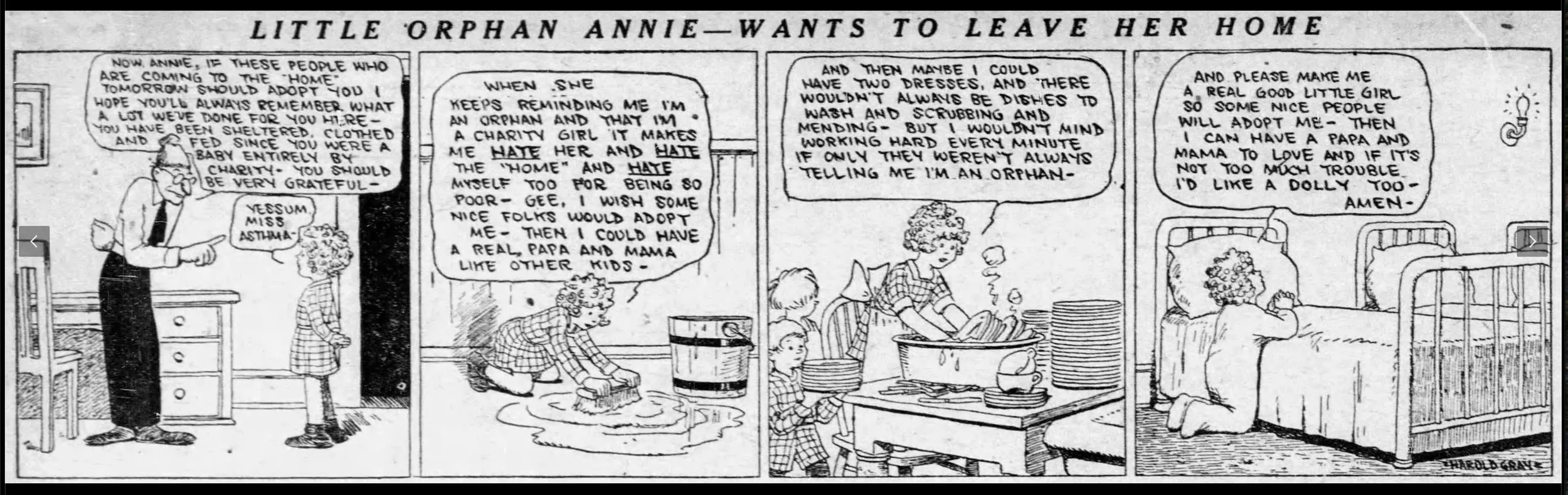
Little Orphan Annie comic strip, New York Daily News
In 1924, Harold Gray first published his comic strip, Little Orphan Annie, in the New York Daily News. The comic follows a string of unrelated adventures in the life of an innocent young girl who wanders the countryside learning about political corruption, criminal gangs, and communism. Very popular in the 30s and 40s, the comic strip ran for 86 years until its cancellation in 2010.
In the 1930s, Harold Gray’s comic stripwas adapted into a radio show and two films. In 1976, Annie the stage musical premiered at the Goodspeed Opera House in CT and the following year on Broadway. Over the next 15 years, three additional musicals were created, none of which had the success of the original. The 1977 Broadway musical later inspired two novels and five film adaptations, the most famous of which was the 1982 movie starring Aileen Quinn, Albert Finney, Carol Burnett, and Ann Reinking.
Nile Scott Studios
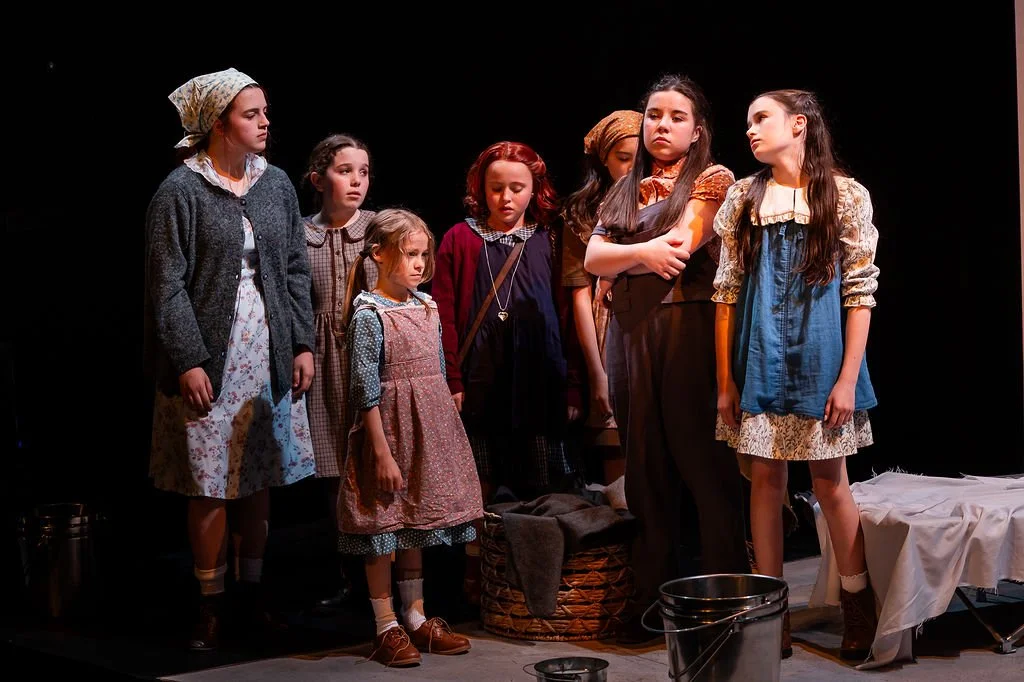
Greater Boston Stage Company is continuing this long-standing Annie-loving tradition with their current production, starring Helen M. Brady and Livia Quist in the title role. I saw the “Blue Cast,” which starred Livia Quist who was the best singer in the show. Quist is only 10-years-old, but her voice had the tone, richness, and power of a much older, more experienced singer. She has a lot to learn about acting (who wouldn’t at 10-years-old?), but her singing was genuinely impressive. Quist is supported by a stellar group of six young performers who play the other orphans (Brenna Brien as Pepper and Maya Feldman as Duffy were particularly strong).
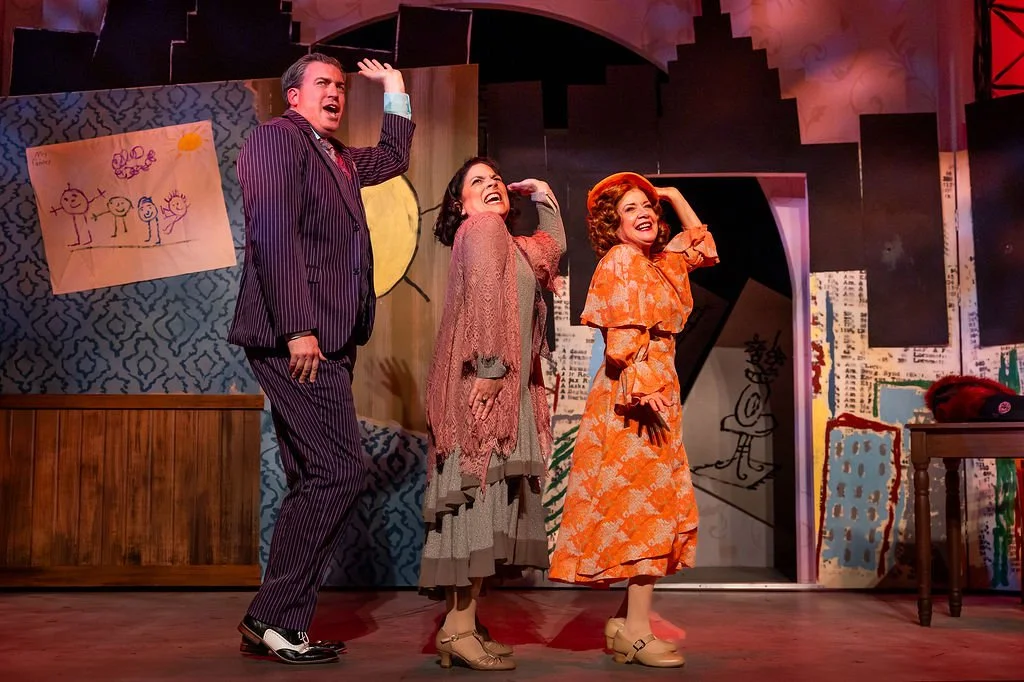
The nine-person ensemble holds this production together with their dedicated, reliable performances, effortlessly switching between the people of NYC, Warbucks staff, FDR’s staff, and the cast of Bert Healy’s radio show. The lead adult cast members, on the other hand, were a mixed bag. De’Lon Grant brought a steadiness and warmth to the haphazardly written role of Oliver Warbucks. Tader Shipley was lovely as Grace Farrell, a character that is much more interesting in the 1982 film with the addition of extra songs and scenes. While Ceit Zweil’s choreography was delightfully watchable, she was miscast in the role of Miss Hannigan. Her grating, over-the-top performance went way beyond camp into unhinged. Mark Linehan played Hannigan’s brother, Rooster, with just the right amount of snazzy and sleazy, but Kathy St. George, while engaging and fun to watch, was far too old for the role of Rooster’s girlfriend, Lily.
Nile Scott Studios
Costume designer Kelly Baker does an excellent job designating place, class, and character with her dozens of costumes all of which have their own flair, texture, and pattern to tell you who these people are. The most memorable costume was a well-tailored but not quite fashionable purple pinstripe suit for Rooster.
Katy Monthei’s playful, adaptable set appears to be drawn by a child and a handful of markers, with each “world” opening like pages of a storybook (i.e. the orphanage, Miss Hannigan’s office, the streets of NYC, Warbuck’s home, the White House), as if to suggest that the places we are seeing are presented through the eyes of an unhappy– but hopeful– orphan girl. While the orphanage is covered in torn, stained wallpaper, the walls of the girls’ bedroom also have hand-drawn pictures of friends, a giant sun, and a cheerful rainbow across the door. On the streets of NYC, the nearby buildings are messy and full of color while the towering, shadowy skyscrapers are filled with a darkness a young girl can’t comprehend. Warbuck’s home has bright, white walls with dozens of lifeless drawings of decorative accoutrement, but later– once Annie has put her stamp on the place– it has drawings of Santa and Daddy Warbucks taped to the wall, and a paper Christmas tree as tall as the ceiling.

Nile Scott Studios
For its unforgettable, foot-tapping songs like “It’s the Hard Knock Life,” “Easy Street,” and “…Without a Smile” (not to mention the sickly sweet core number, “Tomorrow”), Annie is a disarmingly cheerful musical with very dark undertones. It takes place during the Great Depression while billionaires like Oliver Warbucks are hoarding (and ceaselessly increasing) their obscene wealth in a country where millions of people are suffering from poverty and unemployment. Capitalism and communism have taken over the world, and corruption is rampant. The orphans are starving, being abused, and forced into manual labor. This is not a happy story. But add a cute little girl, a dog, and some snappy dance numbers and, suddenly, people start to forget their troubles; they start to forget how dark and dangerous the world is.
Perhaps, for some, that is the goal in producing a show like this. I don’t blame people for wanting that. All of the horrible realities masked by the musical’s incessant charm are– shockingly– almost exactly the same today, nearly a century after the story takes place. Maybe Annie is a way to escape those realities for a couple of hours. For others, Annie is simply about maintaining optimism in the face of all this darkness. If only knowing that “the sun will come out tomorrow,” was enough to keep people from suffering. If only a girl and her dog really could change the world.
