CST’s ‘Breaking the code’ is not to be missed
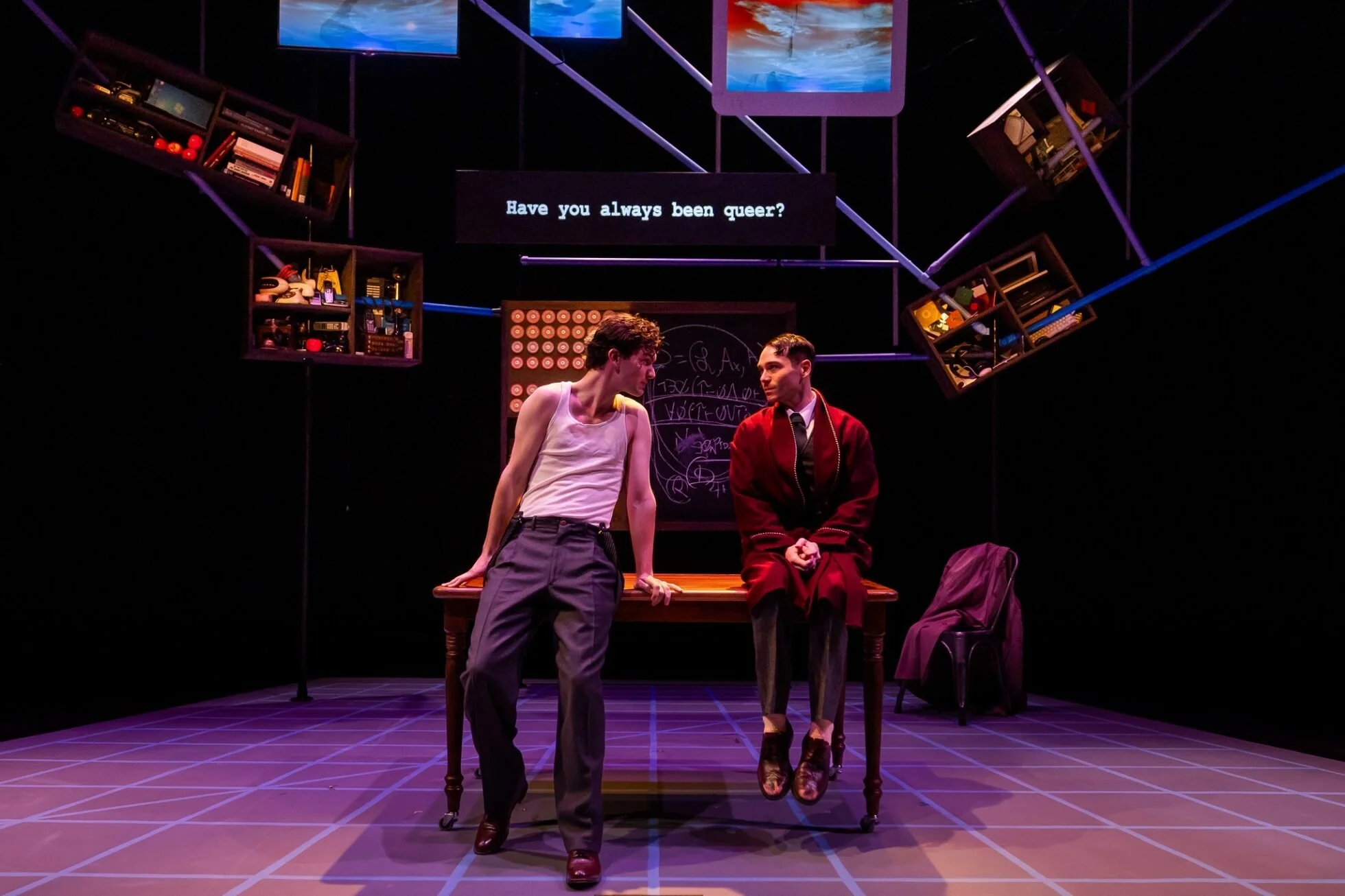
Photo: Nile Scott Studio
Many of us have heard the name Alan Turing, but few know much more about him than what he is most known for: breaking the Nazi Enigma code, which helped bring an end to WWII. Known as the father of computer science, Alan Turing was a pioneering English mathematician and cryptographer. In 1936, at just 24 years old, he developed the Universal Turing Machine, which would later lead to the creation of the first modern computer. During the Second World War, he worked as a codebreaker for the British government, creating a machine that could decode the German military’s encrypted transmissions, which likely saved millions of lives. In 1950, he published a paper that asked, “Can machines think?” which became the foundation for artificial intelligence.
Turing was also openly homosexual at a time when men could be jailed and subjected to barbaric treatments to “cure” them of what was then considered a preventable disease. In 1952, he was arrested and charged with “gross indecency” for unapologetically admitting to having a relationship with another man. His punishment was chemical castration, a series of hormone injections that reduced his libido, left him impotent, and caused breast tissue to form. Then deemed untrustworthy and a security risk to the British Foreign Office, he was harassed by police surveillance until 1954, when he took his own life.
Central Square Theater’s stirring production of Hugh Whitemore’s Breaking the Code follows the turbulent but brilliant life of one of the world’s most important thinkers. The play begins in 1952 in a police investigation room. Having just reported a minor burglary in his home, Turing’s tale becomes tangled when the investigator starts poking him for details about his personal life. Cornered by the questioning, Turing retreats into a 30-year, non-linear journey through his mind, where we learn of his many triumphs, losses, and loves.
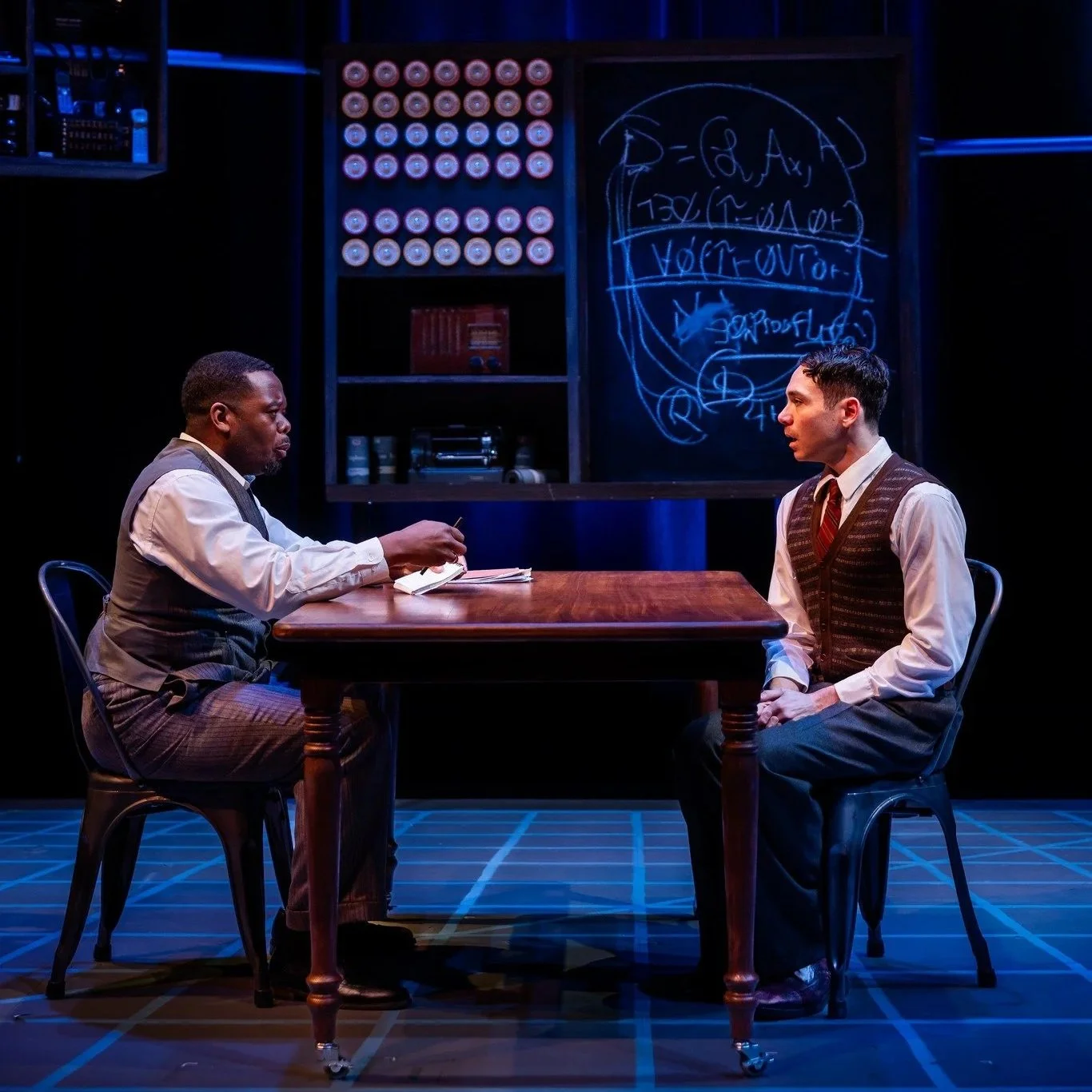
Photo: Nile Scott Studio
Eddie Shields gives a superb performance in the leading role. Expertly pivoting back and forth between Turing as a young man and Turing in middle age, Shields makes smart, thoughtful choices that easily distinguish his character at different times in his life. He deftly exhibits Turing’s nervous habits (e.g., stuttering, nail-biting, blinking) without pushing them too far. His nimble control of Whitemore’s long, complex speeches about the beauty in mathematical perfection is, truly, a sight to behold.
Shields is surrounded by an equally stellar supporting cast. Paula Plum (Sara Turing) and David Bryan Jackson (John Smith, Dillwyn Knox) are delightful and believably British in both voice and physicality. Matthew Beagan brings confidence and charm to his four very different–and distinctly portrayed–roles. Josephine Moshiri Elwood exudes warmth and kindness as Turing’s friend and fellow mathematician, Pat Green. And Dom Carter brings a quiet sympathy to the role of Mick Ross, the investigator.
Scott Edmiston’s direction is exquisitely crafted. His staging is intentional, and he keeps the actors moving steadily (sometimes even speedily) within and between scenes, never leaving room for a dip in attention. He has also gathered a solid design team that has created an exciting theatrical world for the actors to play in.

Photo: Nile Scott Studio
Of particular note was Janie E. Howland’s set design, which is spare but intriguing. With no walls, nothing is being concealed. Symbolically, this works well in a play that centers on an interrogation of Turing’s homosexuality–something he refuses to hide. Shaped like an isosceles trapezoid (for the non-math nerds, trapezoids are often used to explore angles or, in this case, thoughts), a backdrop of TV screens is connected by scaffolding and strips of bright neon light. The five screens are meant, perhaps, to symbolize the five major parts of the brain, with each screen displaying images that change along with Turing’s thoughts, memories, ideas, and feelings. The acting space on the floor mirrors the shape of the webbed screens above and gives the impression that the entire play is taking place inside of Turing’s mind. This becomes all the more clear when he describes a recurring nightmare in which he is “trapped inside an enormous mechanical brain.”
In 2013, nearly 60 years after his death, Turing was pardoned for his conviction of “gross indecency” and honored for his contributions to the war effort. While much has changed since his death, much is still the same. More than 60 countries still have laws that criminalize homosexuality. Conversion therapy occurs nearly everywhere in the world, including the U.S., where it is legal in 20 states. Twelve countries have laws that impose the death penalty for homosexual activity. As Turing said in his 1950 paper regarding computer intelligence, “we can see plenty…that [still] needs to be done.”
Breaking the Code is the story of an extraordinary man that history almost forgot. Thankfully, Central Square Theater has reminded us of that story with their beautifully realized production. This show is not to be missed.
