ASP Brings modern ‘little women’ to watertown
Benjamin Rose Photography
It takes courage to adapt such a widely beloved novel as Louisa May Alcott’s Little Women. Playwright Kate Hamill’s bold theatrical reimaginings of classic literature have, themselves, become hugely popular amongst regional theater companies. Hamill has been named one of the most produced playwrights in America every season since 2017, and Boston theater companies have been producing her plays for years (i.e., The Odyssey, Ms. Holmes & Ms. Watson, Emma, Dracula, Vanity Fair, Pride and Prejudice, Sense and Sensibility). Hamill’s unique skill is taking a well-known story, maintaining its core themes, and then turning it on its head by presenting the story through a decidedly contemporary and/or feminist lens and offering a fresh, unexpected perspective of characters we know and love.
Sadly, Hamill’s adaptation of Little Women lacks the wit and flair of her other works. The play preserves most of the familiar character traits of the March family with a few modern adjustments. Jo and Amy are written for Black actors. Marmee is less of a central figure in the story, allowing for the focus to be on Jo, who is quietly Queer in Hamill’s interpretation. In Actors’ Shakespeare Project’s production, it was difficult to discern whether Hamill had reimagined Meg to be naive and insensitive, rather than the mature, reserved character we know, or if the actor playing the role (Olivia Fenton) completely misinterpreted how Meg was written. When you come to see a Kate Hamill play, you come expecting something different; you come expecting to experience a familiar story in a new way, but much of Little Women is, frustratingly, too similar to Alcott’s novel. The play is very un-Hamill-like in that it’s a little too agreeable, comfortable, and pleasant.
That being said, Hamill’s script does take some liberties with the original text– especially in her choice of ending. One change worth applauding was her choice to omit Jo and Amy leaving the family home and, eventually, marrying men to whom neither girl is really suited. Choosing, instead, to end the story with Beth’s death emphasizes Jo’s and, by extension, Alcott’s desire to keep the family together as long as possible and to keep them all “alive” forever by way of Little Women itself. More importantly, in not forcing Jo to take the traditional route of marriage– the only “appropriate” choice for a young woman in the mid 1860s– it allows modern audiences to imagine an alternate reality for a character who, many literary theorists and readers alike have argued, has always come across as Queer. In Alcott’s novel, Jo’s family often describes her as “boyish” and “unladylike,” and Jo herself laments, “I can’t get over my disappointment in not being a boy.” In Hamill’s play, Jo admits, “I’m not like other women,” to which Marmee (Sarah Newhouse) lovingly replies, “You don’t have to be.”
Benjamin Rose Photography
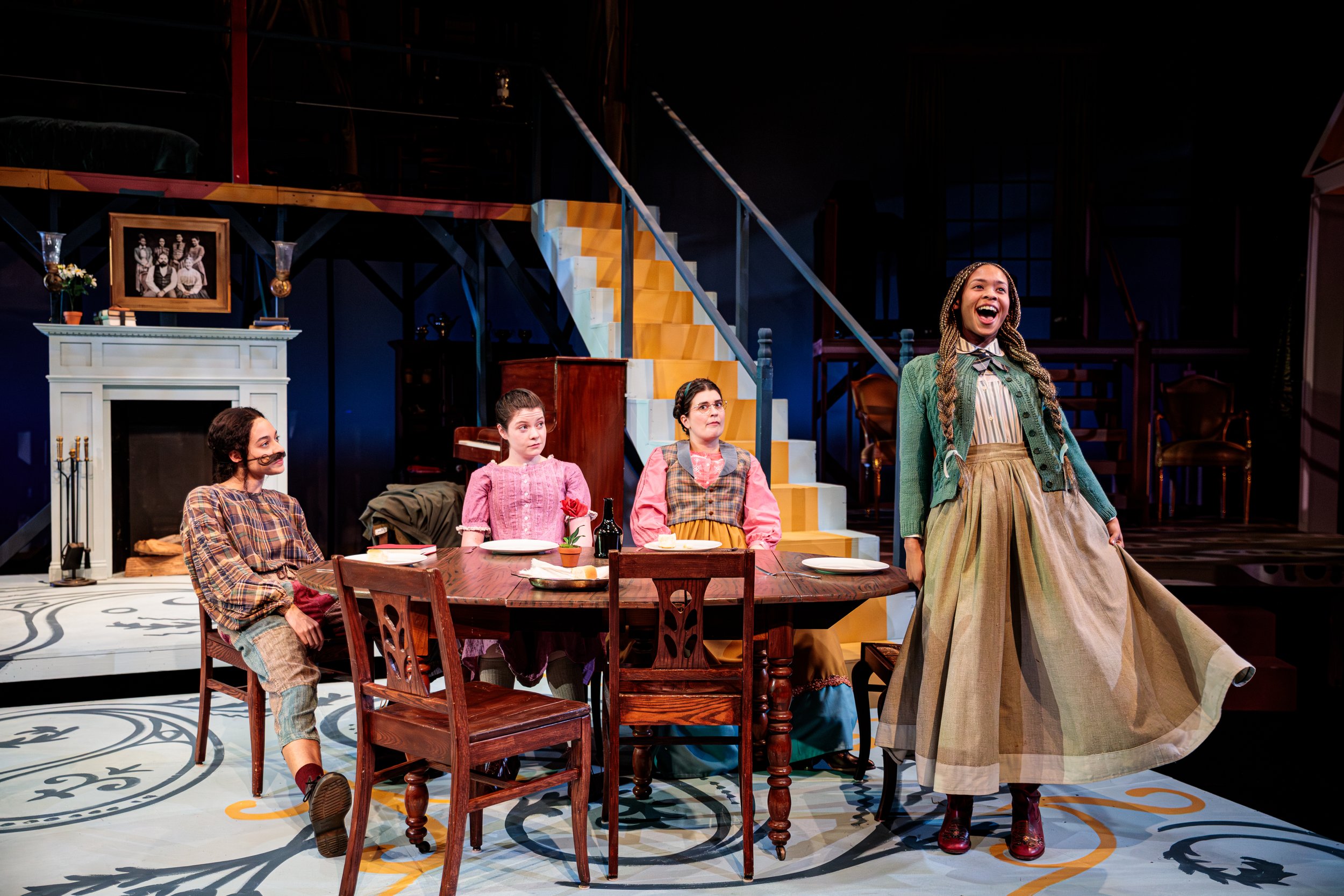
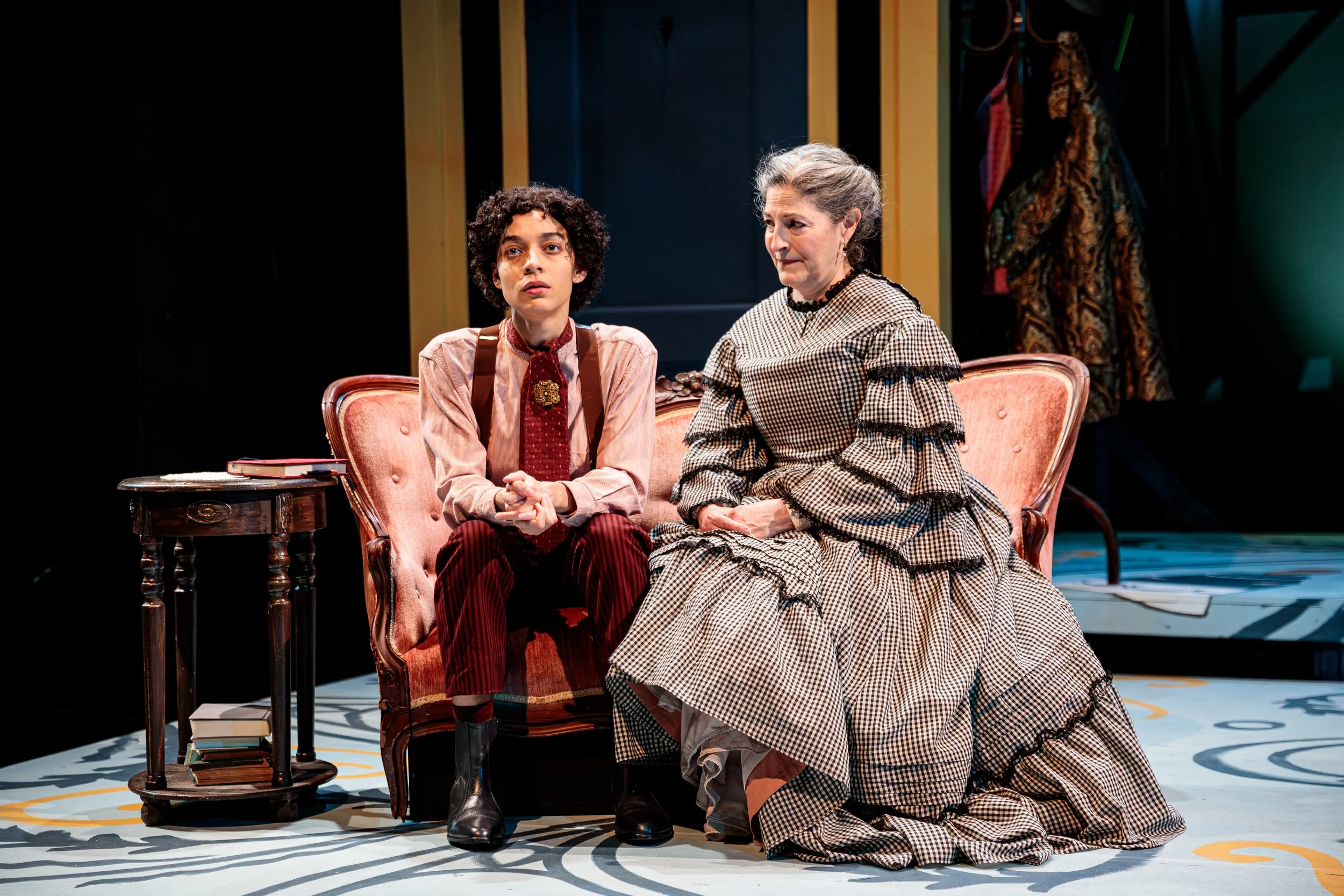
Costume Designer Zoe Sundra highlights Jo’s “difference” in Act I by putting the character in heavy boots, high-water patchwork pants, and a baggy plaid shirt. In Act II, Sundra brilliantly elevates Jo’s style to include red pinstripe pants, a fitted peach button-up shirt with a red cravat, maroon suspenders, and a tophat. Sundra’s design for the other March sisters is just as intentional. Her thoughtful choices easily give you a sense of who the characters are, using mismatched colors and patterns with tired, faded fabrics to draw attention to the family’s financial hardship. Meg’s muted mustard skirt has six-inches of blue fabric stitched on the bottom, which suggests that that was a more affordable option than buying a new skirt. Beth’s girlish pink dress is several inches too short, revealing her white bloomers underneath. And Amy’s clothes, while still modest, appear more put together with flattering, matching colors and form-fitting shapes.
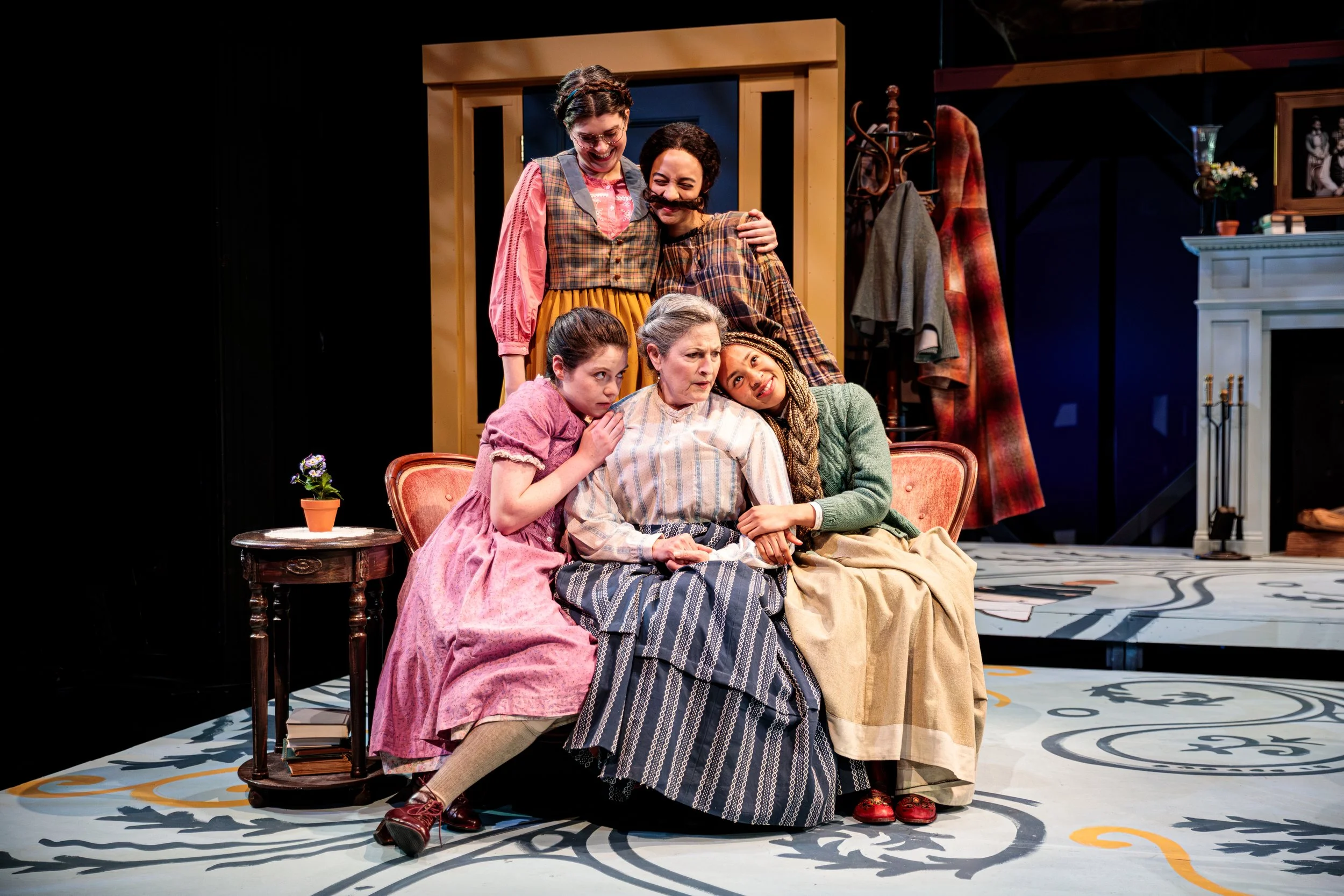
The simple but effective set (Jenna MacFarland Lord) and scenic designs (Danielle Ibrahim) also help to tell the Little Women story. The March home is accented with soft blues and warm yellows, which bring light and life into a humble space decorated with flowers, chairs, jackets, and books. Significantly, the March family photo hangs above the fireplace at the center of the home. The staircase that leads to Jo & Beth’s bedrooms has a prominent yellow stripe down the center, acting as a kind of connecting thread between the space where most of the life happens in the home (the living room) and the space where that life is preserved (at Jo’s writing desk). In the living room, the sisters perform Jo’s “theatricals,” Marmee and the girls celebrate Christmas, Beth becomes ill, Mr. March returns home from the Civil War, Amy burns Jo’s manuscript, Meg brings her twins to meet the family, Laurie kisses Jo, and Beth dies. At her writing desk, Jo records all of these memories to keep the family together because “even if the world had split apart, together they were whole.”
Benjamin Rose Photography
Excluding the intentionally silly scenes in which Laurie and the sisters perform Jo’s fantastical “theatricals,” the younger actors, Jonah Barricklo (Laurie), Olivia Fenton (Meg), Kaila Pelton-Flavin (Beth), and Chloe McFarlane (Amy) were led slightly astray by director Shana Gozansky, who should have reigned in their exaggerated performances. Several scenes felt more melodramatic than dramatic due to the actors pushing their emotions, which had the unfortunate effect of zapping the audience’s ability to feel anything. The one exception to this was actor Aislinn Brophy. Brophy brings charisma and dynamism to the role of Jo. Their enthusiastic, youthful energy is balanced beautifully by a sense of sincerity and melancholy, making for a very rich portrayal.
At the center of Louisa May Alcott’s Little Women is a family led by a wise and compassionate mother who lets her children be different from each other, a mother who never attempts to force her daughters to be anyone but themselves, thus allowing them to pursue their own futures. At the center of Kate Hamill’s Little Women is a young person who doesn’t fit in and yet is fiercely, bravely herself, someone who doesn’t conform to society’s expectations of what a woman should be. “If I were a boy,” Jo insists, “people would care more about what I could do instead of what I should do.” Perhaps this is why Alcott’s Little Women lives on and why Hamill felt compelled to adapt the work 150 years after it was written. Women all over the world– especially Black women, Queer people, and non-binary folks– are still fighting to be who they are, love who they want, and choose what they do. Stories that uplift characters like Jo continue to be of interest because they are still unfortunately, infuriatingly relevant.
